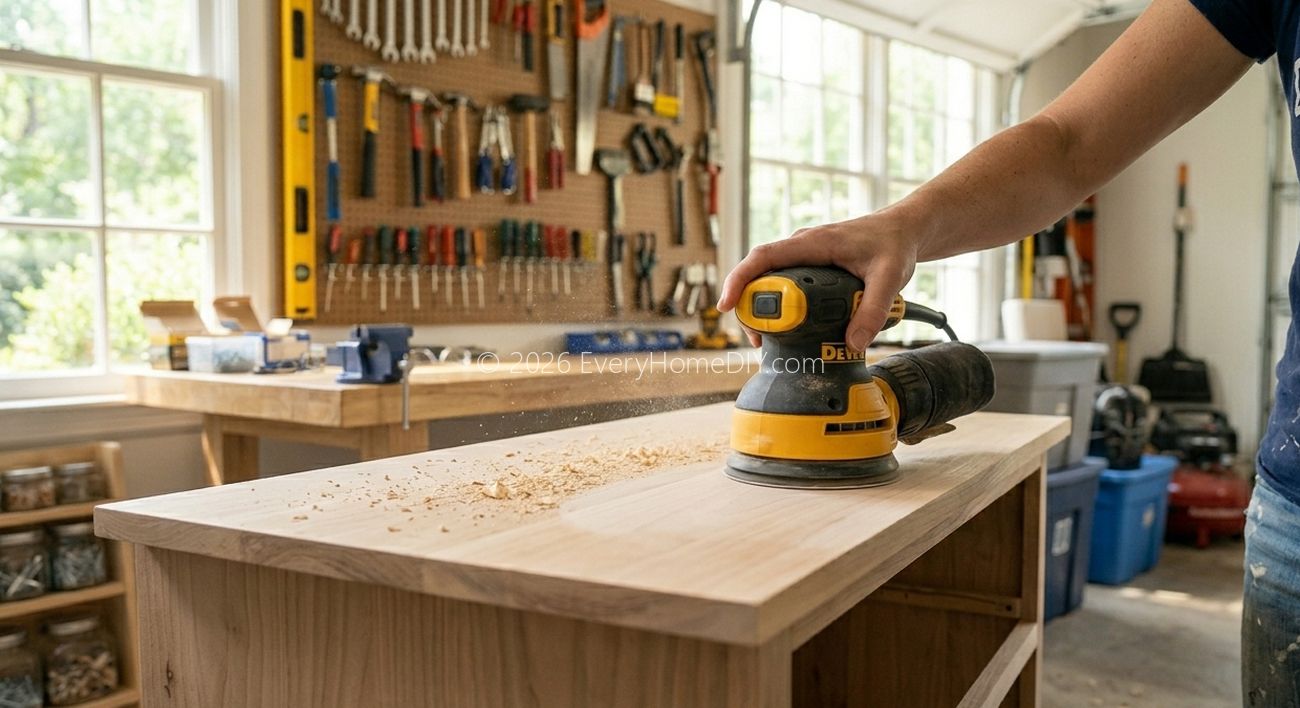
Which Type of Sander Do You Need?
Before buying, you need to know which type of sander fits your project:
- Random Orbit Sander: The most versatile. Moves in a random elliptical pattern that leaves no visible swirl marks. Best for furniture, cabinets, floors, and general finishing work.
- Belt Sander: Aggressive material removal. Best for flattening large surfaces quickly, removing paint or finish, or smoothing rough-cut lumber. Not for fine finishing.
- Detail/Corner Sander: Triangular pad gets into corners and tight spaces. Best as a complement to a random orbit sander.
- Sheet/Orbital Sander: Entry-level option for light sanding. Slower than random orbit, leaves more swirl marks. Fine for paint prep but not finish work.
For most homeowners, a 5-inch random orbit sander handles 90% of projects.
1. DEWALT DCW210B — Best Cordless Random Orbit
The DEWALT DCW210B is the cordless random orbit sander that professional finishers reach for. The brushless motor delivers consistent power at all speeds, the variable speed dial (8,000–12,000 OPM) handles everything from aggressive stock removal to final finishing, and the 5-inch pad accepts standard hook-and-loop discs available at any hardware store. Runs on the 20V MAX battery platform — same batteries as your DEWALT drill.
2. Makita BO5041 — Best Corded for Heavy Use
If you're doing extensive sanding work — stripping a deck, refinishing multiple pieces of furniture — a corded sander like the Makita BO5041 eliminates battery anxiety. The 3-amp motor maintains consistent speed under load, and the 8-hole pad provides superior dust collection compared to 5-hole designs.
3. Black+Decker BDERO600 — Best Budget Option
For occasional sanding projects, the Black+Decker BDERO600 delivers adequate performance at around $30. It won't match the power or dust collection of premium models, but for touching up furniture, light prep work, and infrequent use, it does the job without a significant investment.
Sandpaper Grit Guide
- 40–60 grit: Heavy material removal, stripping paint or finish
- 80–100 grit: Removing scratches from previous sanding, rough shaping
- 120–150 grit: General smoothing, prep before staining
- 180–220 grit: Fine finishing, between-coat sanding
- 320+ grit: Ultra-fine finish, wet sanding
Always progress through grits in sequence — skipping grits leaves scratch patterns that show through paint and stain.