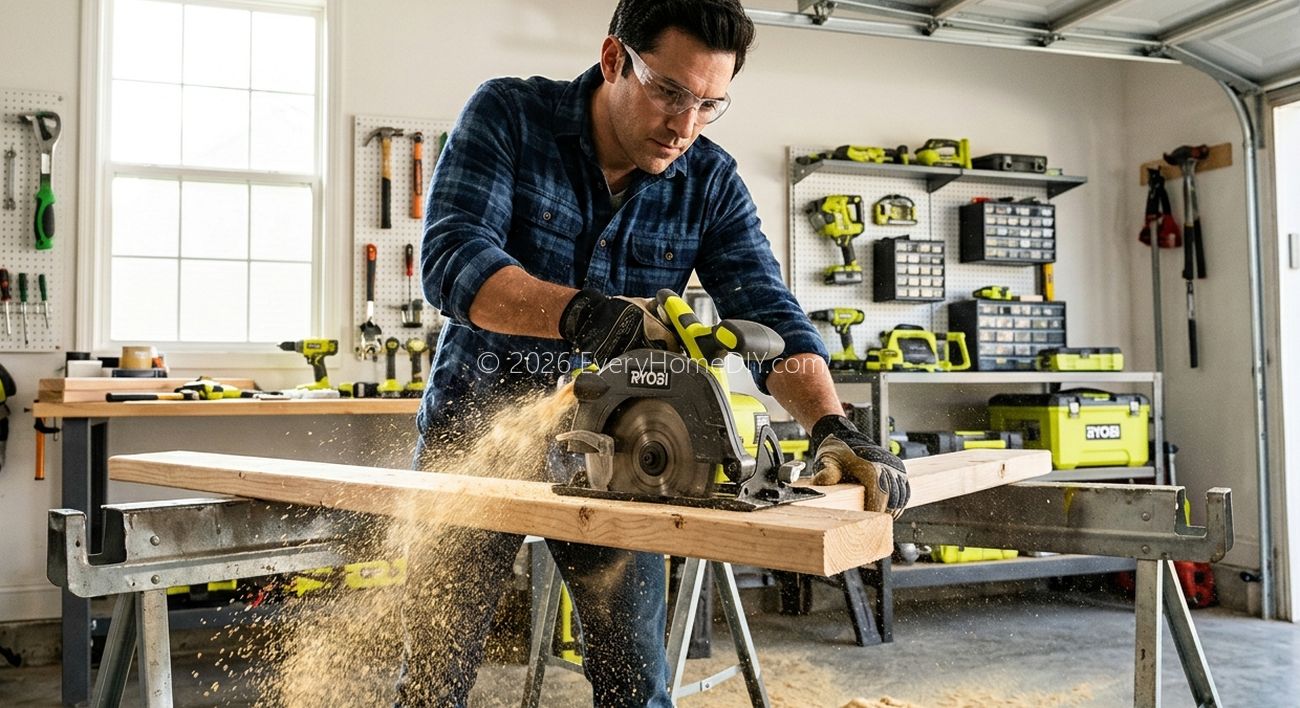
Do You Need a Circular Saw?
If you ever cut lumber, sheet plywood, decking boards, or framing lumber, yes. A circular saw is the second power tool to own after a drill. Once you have one, you can build raised garden beds, cut shelving to size, trim door casings, build a workbench, and tackle dozens of projects that require more than just drilling holes. A cordless model gives you all the capability with full portability.
Key Specs to Compare
- Blade size: 7-1/4 inch is the standard for full cutting depth. 6-1/2 inch is more compact and lighter.
- Bevel capacity: 45–56 degrees of bevel adjustment covers all standard cuts. 56 degrees lets you cut compound angles without repositioning
- No-load speed: 4,500–5,500 RPM is the working range for wood cutting
- Blade side: Left-blade (motor left, blade right) is better for right-handed users because you can see the cut line easily
1. DEWALT DCS565B — Best Overall 6-1/2 Inch
The DEWALT DCS565B runs on the 20V MAX platform and delivers 5,150 RPM through a 6-1/2 inch blade. The compact, lightweight design (4.2 lbs without battery) reduces fatigue on long cuts, and the improved sight line gives you a clear view of your cut mark. The 50-degree bevel adjustment handles most compound cuts. Compatible with all 20V MAX batteries.
2. Milwaukee 2730-20 M18 FUEL 7-1/4 Inch — Best Performance
The Milwaukee M18 FUEL circular saw is in a performance class of its own. The POWERSTATE brushless motor delivers 5,000 RPM of consistent power through a 7-1/4 inch blade, handles the full depth of 2x lumber in a single pass, and doesn't bog down in dense or wet lumber the way cheaper saws do. If you're building a deck, cutting framing lumber, or doing serious DIY work, this is the tool to own.
3. Ryobi PBLCS300B — Best Value
The Ryobi PBLCS300B brings brushless motor technology to an affordable price point. For homeowners who need a circular saw occasionally rather than daily, it delivers enough power and cutting accuracy for standard DIY tasks at a fraction of the Milwaukee price. Runs on the Ryobi ONE+ battery platform.
Blade Selection
- 24-tooth blade: Fast cuts in framing lumber and construction wood. Rough cut, lots of tearout — not for finish work
- 40-tooth blade: General purpose — the right blade for most homeowner tasks
- 60–80-tooth blade: Fine finish cuts in plywood, MDF, and trim. Slower cutting but smooth edges
Always use a blade designed for your material. Using a wood blade on metal or fiber cement will destroy it immediately and is a safety hazard.